3 min read
Avoid Feature Creep in Enterprise Design at All Costs
Why adding “just one more thing” slowly breaks great products.

Every large project has that moment.
The team is deep into building. Deadlines are real. Budgets are tight. And someone says, “While we’re at it, let’s add this too.”
It sounds reasonable. It sounds helpful. It even sounds smart.
But that sentence is often the start of feature creep.
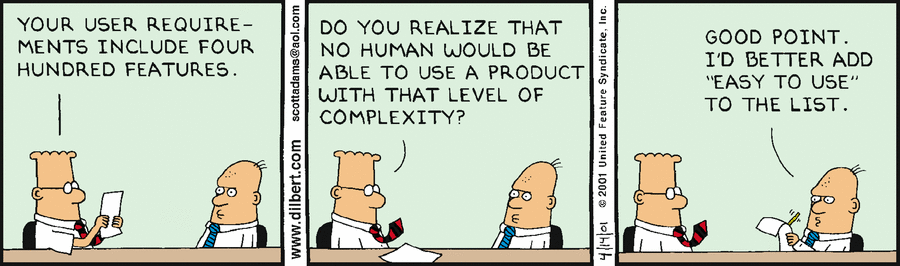
Feature creep happens when new features or changes are added beyond the original scope of a project. At first, the additions seem small. A new filter. A new setting. A small improvement that feels easy to include. But these changes pile up. And once they are added, they rarely get removed.
Over time, the product grows heavier. It becomes more complex. And complexity always comes with a cost.
In enterprise design, this cost multiplies. More features can mean more help desk calls, more support tickets, more training, more documentation, and more long-term maintenance. What looked like a small addition can quietly affect the entire system.
The problem is not that teams want to improve the product. The problem is that improvement is often confused with expansion.
In software, features feel easy to add. If it can be built, someone will suggest building it. With every new release, something new gets added. Very rarely does something get removed. The product keeps growing, but it does not always get better.
Another reason feature creep happens is because of internal pressure. Stakeholders believe they know what customers want. Leaders want to leave their mark. Teams want to show value. Features get added to satisfy internal audiences instead of solving real user problems.
This creates a false belief that more features equal more value.
But as consumers, we know that is not always true.
Think about a device packed with dozens of features. It looks impressive in the store. But once you bring it home, you may only use a small portion of what it offers. The rest becomes clutter.
There was a study by Philips Electronics that found nearly half of returned products were not broken. Customers returned them because they were too complicated to use. Not defective. Just overwhelming.

That insight led Philips to focus on simplicity. Because simple products often win.
Not because they do less. But because they do what matters well.
In enterprise design, feature creep can have two outcomes. In the best case, it increases time and cost without improving the experience. In the worst case, it creates performance issues, usability problems, and technical debt that slows future work.
The danger is not dramatic. It is gradual. Each feature adds a little more complexity. Each release adds a little more weight. And slowly, the product becomes harder to manage, harder to use, and harder to maintain.
Avoiding feature creep requires discipline.
It starts with focusing on business needs. The problem should guide the solution. The solution should guide what gets built. Not the other way around.
It also requires listening to real users. The people who actually use the product every day should have a stronger voice than those who simply approve budgets or attend meetings. Features should exist to solve real pain points, not to satisfy internal opinions.
It also helps to ask a simple question during every update: What can we remove? Subtraction is just as important as addition. A clean system is easier to scale than a cluttered one.
Strong teams also set clear boundaries. At some point, feature requests must stop. Without that boundary, scope keeps expanding, timelines stretch, and focus fades.
Feature creep does not destroy projects in one big moment. It weakens them slowly. One extra feature at a time.
In enterprise design, focus is power. Every feature should earn its place. Because the next feature you add might be the one that breaks the balance.
The goal is not to build the product with the most features.
The goal is to build the product that works best.
And sometimes, the smartest move is not adding something new.
It is protecting what already works.